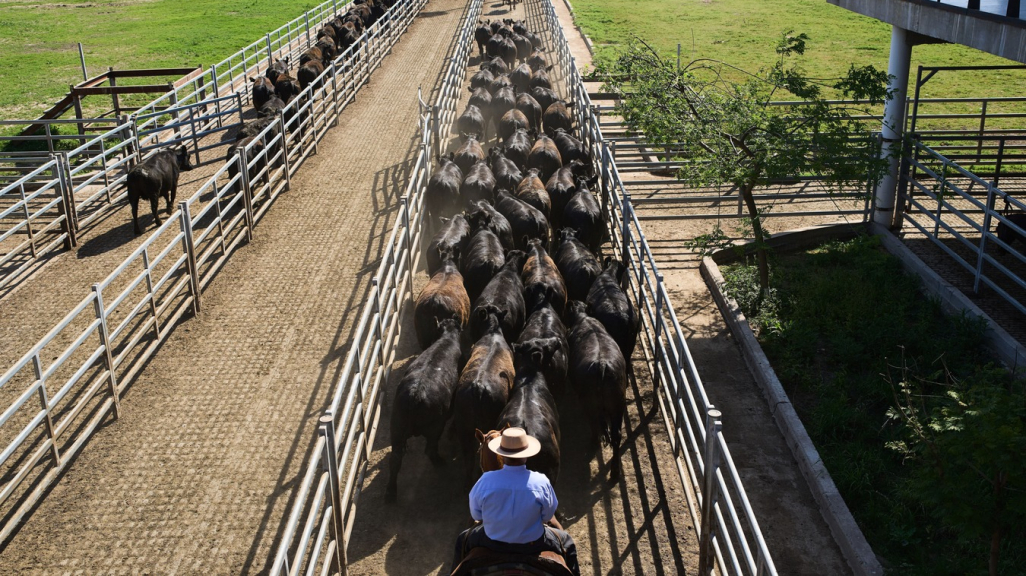
LatAm in Focus: What's on the Trade Menu? Beef
LatAm in Focus: What's on the Trade Menu? Beef
Argentine foreign affairs expert Francisco Resnicoff covers how the sale of South American red meat is shifting through new trade pacts and relationships.
When the United States and Argentina signed a bilateral trade deal in February, one part of the agreement turned heads: Washington would be quadrupling the amount of tariff-free beef it would allow to be imported from the South American country.
Historically, the United States, like countries across the world, limits the amount of beef it imports to promote its domestic ranching industry. But with U.S. consumer prices high—and a strong relationship between the administrations of U.S. President Donald Trump and Argentine President Javier Milei—Washington increased its quota.
“The beef part of the deal ... that's a huge win for Argentina and that is presented locally as the main concession of the U.S. to Argentina,” Universidad Austral’s Francisco Resnicoff tells AS/COA Online’s Chase Harrison in this episode of Latin America in Focus.
The U.S–Argentina agreement isn’t the only trade accord with the potential to shift the South American beef trade and affect the economies of major regional producers like Argentina, Brazil, and Uruguay. Resnicoff also explains that the EU–Mercosur agreement, signed at the beginning of the year, raised questions of how much South American beef Europe wanted to let into its borders, amid protests from European ranchers.
And then there’s China. "There's a huge event in the global beef market, which is the eruption of China as a consumer,” explained Resnicoff. Over the past decade, Chinese demand helped drive the South American beef market. This year, however, Beijing began to impose their own quotas, limiting imports.
How are South American cattlers navigating these shifting global import rules? Will the U.S.–Argentina agreement forever change the beef on U.S. plates? And what does the beef trade have to do with upcoming election in countries like Brazil? Resnicoff digs in.
Our guest

Francisco Resnicoff is founder and senior fellow at the Center of International Strategies for Governments and Organizations (CIG), Universidad Austral, where he supports subnational governments in developing and strengthening their international integration strategies. He also serves as executive director of Fundación Movimiento al Desarrollo and is a member of the Argentine Council on International Relations (CARI). He previously served eight years as undersecretary of international and institutional relations at the Buenos Aires City Government. Earlier in his career, he was senior advisor to the secretary of agriculture, livestock, and fisheries of Argentina.

Subscribe to Latin America in Focus, AS/COA's podcast focusing on the latest trends in politics, economics, and culture throughout the Americas.
This episode was produced by Camilo Salas and Luisa Leme. Carin Zissis is the host.
Share and subscribe at Apple, Spotify,YouTube, or wherever you get your podcasts. Access other episodes of Latin America in Focus and send us feedback at latamfocus@as-coa.org.
Francisco Resnicoff previously joined the podcast to discuss the 2024 G20. Listen to the episode.
The music in the podcast is “Chacarera en el aire," performed by Nicolás Fioravanti for Americas Society. Find out about upcoming concerts at musicoftheamericas.org
Opinions expressed in this podcast do not necessarily reflect those of Americas Society/Council of the Americas or its members.
[MUSIC PLAYING]
[1993s commercial by the Beef Industrial Council and Beef Board]
Carin Zissis: Remember that commercial? Beef, it's what's for dinner! Well, it's also on the trade agenda. Yes, the protein, a major South American export, took center stage in a recent trade deal between the United States and Argentina, a country world renowned for, it's asado.
President Donald Trump: I assume you're talking about beef, to get beef prices down. The only price we have that's high is beef and we'll get that down. And one of the things we're thinking about doing is beef from Argentina.
[SOFT MUSIC PLAYING]
Zissis: Hi, this is Carin Zissis from AS/COA Online. Welcome back to Latin America in Focus. I hope you're hungry for this episode because in a February deal, Washington quadrupled the amount of beef it's willing to import from Argentina without additional tariffs, opening the U.S. consumer market to South American steaks like never before.
And it's not the only trade maneuver that has shifted the regional shipments of meat. Beef was one of the many Brazilian products that faced steep U.S. tariffs last year until a Trump-Lula meeting in November resulted in easing of that extra levy. And across the ocean, during years of EU-Mercosur trade negotiations, European cattlers battled to keep South American meat out of their markets. That agreement was finally signed at the start of this year. And then there's China.
Francisco Resnicoff: So China has become the vacuum cleaner of beef globally until very recently. They had a system with little restrictions to import because they needed so much beef. Since January of this year, 2026, they started implementing a quota system as well.
Zissis: That's Francisco Resnicoff, senior fellow at Austral University's School of Government, who's from Argentina and worked on trade with the Buenos Aires government. He joined us for an episode last year about the G20 and is back now on Latin American in Focus to talk with my colleague Chase Harrison. Among other things, Resnicoff spoke about how beef producers—Argentina, Brazil, and Uruguay—are weathering global trade shifts and what that means for cattlers and presidents alike.
[MUSIC FADES]
Thank you for joining us. Whether you're listening in Mendoza, Manhattan, or Mexico City. If you like this episode, share with a friend and help us out. Rate Latin American on Focus on Apple, Spotify, or your podcast platform of choice.
[UPBEAT MUSIC PLAYS]
[SHOW INTRO WITH UPBEAT MUSIC – Latin America in Focus Podcast]
VOICE OVER: You’re listening to Latin America in Focus.
VOICE OVER 2: Latinoamérica en foco
VOICE OVER 3: América Latina em foco
VOICE OVER 1: A podcast by Americas Society/Council of the Americas on politics, economics, and culture in the region.
Chase Harrison: Francisco, welcome back to the Latin America in Focus podcast!
Resnicoff: Thank you for having me, Chase.
Harrison: We're here today to talk about beef and the country you're from, Argentina, is known for its beef. It's right up there as one of those iconic Argentine things like Malbec [wine], tango, or gauchos. But as it turns out, not every country wants unlimited Argentine beef because the global beef trade is governed by a system of import and export restrictions. Can you explain a little bit about how this system works and why Argentina can't just send as much of its beef anywhere it wants?
Resnicoff: Sure, that’s a kind of how the market works internationally, and this is true for many agricultural products. Most countries want to protect their production and their producers, their farmers. So many restrictions are in place for exporting these kinds of products. And you can see that in the history of trade, the many restrictions on these kinds of products.
And especially, for example, in the case of Argentina, that's very true for beef, even though demand for beef has been growing a lot in the last few years. There's also a domestic restriction in many countries, but especially in Argentina. We are big fans of beef, eating beef. Together with Uruguay, we are the largest consumers per capita country in the world of beef. That's more or less 50 kilos per person per year. That's a lot. So, there's always the tension between the domestic market and how there's available and cheap beef for everybody in Argentina. That's always in tension with the export market.
Harrison: Because they're trying to protect their domestic markets a lot of countries have a quota system for beef from all countries, including Argentina. What exactly is this quota system?
Resnicoff: Quotas are basically that you can export at a certain level of tariff and if you exceed that quota—that number of tons in general—you pay an additional tax, an additional tariff on that.
So different countries have different systems. Different countries have different tariffs as well. Sometimes those tariffs are lowered if the country needs more imports, for example, to fulfill the domestic demand, and sometimes they're higher if they want to—or they're more interested in—protecting local producers.
And of course, that's not the only restriction, right? Other types of restrictions that many countries impose, which are, for example, related to health issues of cattle, right?
Harrison: So we have the shifting system of quotas and each country has different quotas for how much beef it lets in before it applies additional fees. Over the past, let's say half decade, how has the system changed globally? Have the quotas on a country like Argentina shifted much?
Resnicoff: That depends. There's a huge, I would say, event in the global beef market, which is the eruption of China as a consumer. This is for very different factors. China, in the last 30 years, took out of poverty around 500 million people or 600 million people. Numbers vary. Those people are people that have more money, that are usually considered middle class now, and they usually demand proteins of higher quality. So that what's driving the high demand of beef from China, which is now for many countries in the world, including Argentina, but also Brazil, Uruguay, Australia, in the last few years, China has been the main buyer by far, and it's the largest importer of beef in the world for many years in a row.
Now, just to give you an example, I would say around 75 to 80 percent of total beef exports of Argentina go to China and similar number in Brazil, a similar number in Uruguay and so on, so on, and so forth.
So China has become the vacuum cleaner of beef globally. Until very recently, they had a system with little restrictions to import because they needed so much beef. Since January of this year, 2026, they started implementing a quota system as well.
Harrison: So if we were to ask, where's the beef? The answer is increasingly in China.
Resnicoff: In China. Yes.
Harrison: So there's this big new market of consumers in China. Are they buying the same cuts of beef, the same type of beef, as other countries?
Resnicoff: Well, no, that depends on the level of income and what kind of beef each country imports. So China basically buys frozen meat, which is cheaper than chilled beef, and it's of lower quality, so it pays considerably less than other markets. For example, every single exporter wants to enter the European market because European consumers tend to buy high quality meat, so chilled, boneless beef. That's not the case of China. Or for example, they want to sell to Israel, because Israel buys kosher beef. So that comes with an extra price. Or Halal beef for Arab countries.
Harrison: What kind of beef is the United States buying?
Resnicoff: It depends. For most part, it buys lean beef frozen, which is not as good quality of other types of beef. It uses it to mix it with local beef and produce, for example, hamburgers. So that's the kind of beef that it’s buying right now. But it’s also because it has such a huge market with so many people in the high income that it buys also good quality meat as well.
Harrison: What has this explosion of an export market for beef to China meant for the livestock industry in Argentina?
Resnicoff: I mean, first of all, it became a huge export destination. We had problems to export for many countries for many years due to their export restrictions and also health issues of our cattle. So, for example, the U.S. market was closed for Argentina for 10 years due to mouth disease of our cattle, and there were a lot of restrictions more related to environment for exporting to the United States.
Our production found a new client in China, so it didn't change that much. The production levels of beef in Argentina, for example, our herd—the total cattle that we have in Argentina—that's more or less the same as it was 10 years ago. That's about 50 million cows. That's a little bit more than one per person. But that was very different, for example, for Uruguay or Brazil. In Brazil, cattle production exploded in the last few years, and that's mainly because of China. And the same is the same is true for Uruguay and Australia, for sure as well.
Harrison: Successive administrations in the United States have been concerned about China's growing influence in the region. In South America, China is the number one trade partner of most countries. How has Washington reacted to this gigantic new market for South American beef in China?
Resnicoff: Yeah, I would say not particularly regarding beef, I would say the concern is more general. China has become the number one trade or second trade partner of many countries in the region not because of beef, but because other products, mining products on the one hand, other agricultural products on the other hand, for example, soybeans and such.
But I don't think beef was a big concern in the U.S. The main concern of the U.S. is domestic consumption, I would say, and that was what's driving recent decisions on, on the part of the U.S. government related to the beef trade.
Harrison: Let's talk about that recent decision. You're referring to a trade deal announced in early February between the United States and Argentina, that among other items quadrupled the quota of Argentine beef that was let into the United States. This made major news. Cattle ranchers in the U.S. were upset. Argentine ranchers were ecstatic. What did you make of this trade deal?
Resnicoff: I think this has one main objective on the side of the U.S, which is try to lower the prices of beef in the domestic market. As you might know, you live there—I don't—prices have gone up by a lot on many different products but beef among them. The U.S. administration, the Trump administration, is trying by any means to lower some of the prices of very basic consumption in items. So, beef is one of them.
The idea of the U.S. government is to grant Argentina an additional quota. It already had a 20,000 metric tons quota in place. Now, it’s a quota of 80,000 tons extra, which has one objective, which is lowering prices domestically. That's why I think that extra quota that Argentina got was done or was established outside of the trade and investment deal that Argentina signed with the U.S. because that would imply a long-term commitment. And the objective of the U.S. is very practical and very, you know, short term. So that was done by an executive order, which is some way attached to the general negotiation, but it's different, and which is only for one year. It can be renewed, but it's only for one year. My suspicion is that, if for a series of factors, prices go down, that quota will not be renewed in the following year because of the pressures of local producers and cattlers in the U.S.
Harrison: Just to be clear, you're not expecting that this is a long-term change to the beef trade between these two countries. It's just a stopgap measure to keep prices down.
Resnicoff: Yeah, absolutely. The U.S. is having a huge beef production problem because of restrictions on imports from Mexico and droughts and other issues that happened in the U.S. So beef production in the U.S. is now very low. Yeah, I think it's the lowest in the last few decades, so they need to import beef from other places to keep prices relatively low. If that recovers, I think the deal is not going to be renewed.
Harrison: Still, this deal had to be a major political win for Argentina's President Javier Milei, who has aligned himself with President Donald Trump. What is Javier Milei’s relationship to the beef industry and the ranchers?
Resnicoff: Milei came as a refresh of the political system and mostly with a liberal view on how the economy should work and how Argentina should become a part of the global trade system in general. So that was very much welcomed by the agricultural sector in general, but cattlers, in particular. He also liberated domestic prices, which is very good news for cattlers. For many years, the price in Argentina was heavily intervened.
In general, the agricultural sector, at large, supports Javier Milei's government. So that's one thing.
The other thing is that most of these supporters of Javier Milei also support a clear association with the U.S. So this was welcomed that sense as well, even though the deal itself—the trade and investment deal—is not a particularly good deal for Argentina. If you look at, you know, the technical level. The concessions of the U.S. are not clear and low or small compared to what we give in exchange.
But the beef part of the deal, even though it's in a separate document, that's a huge win for Argentina and that is presented locally as the main concession of the U.S. to Argentina.
Harrison: Argentine ranchers are happy. President Milei is happy. What about other South American countries? What did governments in Brazil or Uruguay think of this privileged access that Argentina now has to the U.S. market?
Resnicoff: Well, I would say two things. First of all, there's a technical discussion within Mercosur, the common market of four countries in the region, Uruguay, Argentina, Brazil, and Paraguay. One of the things that Mercosur has is rule that it has is that it has to negotiate as a bloc. It cannot negotiate with third countries separately. There's a legal discussion on that—if Argentina could and did negotiate by itself. That's actually, I think is correct, but the complaint is still there and has to be solved within the block.
The second one is that everybody wants to sell beef to the U.S. as well. The U.S. is a large consumer of beef and it pays a little bit more than China, for example. So everybody wants to enter that market. Right now, the only one that has this kind of privilege is Argentina.
Brazil is trying to diversify its export markets, but for now it has to pay the tariff that the U.S. have, which is about 25 percent for beef, plus the 10 percent flat tax, that since Liberation Day we have in place. So they can enter the market with a quota, but at a high, a very high tariff compared to Argentina. So, there's kind of that view that Argentina got a good deal. It has to explain within the bloc, within Mercosur, but at the same time, Brazil and others are trying to sell more to the U.S. as well.
Harrison: Another potential new market for these countries is the European Union. At the beginning of this year, Mercosur finally signed a big trade deal with the European Union. It had taken years and years, and people thought it would never pass, but in part, due to shifting global trade, it passed, and beef was a sticking point in this agreement. What did this agreement mean for the beef market and are we soon going to see an Argentine steak on Parisian plates?
Resnicoff: Well, that's a good question. That's a difficult answer. I would try to be brief and explain you why. First the deal is still not in place, right? It has been approved—Argentina and Uruguay already got their approval in Congress, but in Europe still you know, there's a legal discussion in the European Supreme Court being discussed right now.
The European Union grants 99,000 tons quota for Mercosur. That's very good news. So we can export more at a lower tariff. But given all the complaints of local beef producers, local cattlers, the European Union imposed a series of new restrictions to the agreement. So, for example, there are mirror clauses, which means that Argentina has to respect all the environmental regulations that European producers have. There are safeguards, special safeguards, for beef and other products, which means that, for example, if prices go down very quickly, the European Union can start an investigation or there's a surge in imports in the U.S. again, the European Union can started investigation and suspend trade. So there are all these kinds of safeguards which will make trade difficult even though we have the quota.
And there's another thing, which is outside of the agreement, which is very important, which is the deforestation protocol that the European Union has in place and will become mandatory by the end of this year. That's going to create a lot of troubles because that would mean that every single beef that Argentina or Mercosur exports will have to be proven that it comes from an area that has not been under deforestation in the last few years. So there are all ways in which the European Union is trying to protect their own beef production.
Harrison: So there's complications with the European Union, with the U.S. and China and a lot of other countries there's quotas. Is this boxing in cattlers, especially in a country like Brazil, that doesn't have this special agreement with the U.S.? Are they looking for new markets or what's going to happen to all this beef?
Resnicoff: I mean, every single beef exporter wants to diversify, especially because all these troubles, all these problems and all these, I would say, fluctuations among different buyers. So all countries are trying to diversify. Brazil is probably at the front of this, mainly because it has become the larger producer and the larger exporter of beef in the world in the last few years. So they need to sell to different markets.
So they have been trying to enter other nation’s markets, for example, Japan for example, Korea for example, Vietnam. They are already exporting to the Middle East and that is creating a, a lot of problems right now because of the conflict there, but has been trying to sell more to Arab countries.
Harrison: Brazil is also a country that's in an election year and historically Brazilian ranchers have had a fair bit of political power. This struggle to find new markets, this frustration with China, what does it mean politically for Brazil's beef industry?
Resnicoff: Yeah, I don't think there's frustration with China. I mean, they are still the number one export market for Brazilian beef. It is true that China also implemented this quota system and Brazil was relatively punished by the new quota system. So the quota is lower than its current export to China, which means that they will have to export less to China under these conditions. I wouldn't say that that's a problem per se: China. For sure, cattlers and the agricultural sector in general have huge power in Brazil as there's a kind of an agricultural block in Congress, which is very cohesive and it has become very powerful in the last few years and has got huge concessions from the central government.
So, for example, while in Argentina, there's still export taxes for agricultural products including beef. Beef pays a 5 percent export tax in Argentina. Soybeans pay 24 percent, corn 12.5 percent, and so on and so forth. Brazil doesn't have any of these, so Brazilian farmers are able to export without internal taxes to exports.
They are very powerful and I believe that the Brazilian government, whether it is on one political side or another, usually will try to help the Brazilian sector to export more.
Harrison: And before we go, Francisco, I have to ask you: do you have a favorite cut of beef?
Resnicoff: I mean, there's no Argentine that could say no to that. I would say, I can say it in Spanish, but I love bife de chorizo and ojo de bife. Those are my two favorite ones.
Harrison: Great. Well, next time we have you on the podcast, we'll do it as a lunch date. Thank you so much for coming on the podcast, Francisco.
Resnicoff: Thank you, Chase.
[SOFT MUSIC PLAYING]
Zissis: Thanks for listening. I’m your host Carin Zissis. This episode was produced by our associate producer Camilo Salas and executive producer Luisa Leme.
Check out the podcast notes for links, including to get our weekly newsletter covering Washington’s hemispheric policy.
Listen to Francisco’s previous appearance, in which he joined us to talk about the 2024 G20 summit in Brazil.
You can find other episodes of Latin America in Focus at www.as-coa.org/podcast or write us an email telling us what you think at latamfocus@as-coa.org.
Share, write us a review, and subscribe at Apple, Spotify, YouTube, or wherever you get your podcasts.
The music in the podcast was performed for Americas Society. Find out about upcoming concerts at musicoftheamericas.org. And if you like the soundtrack of this podcast, consider becoming an Americas Society member for preferential access to all performances at 680 Park Avenue in New York, as well art exhibitions, book talks, and more exciting events.
Opinions expressed in this podcast do not necessarily reflect those of Americas Society/Council of the Americas or its members. Thank you.